
An Exploratory Study From Two Danish Prisons
Prisonchess
& Dynamic Security
Can Structured Chess Strengthen Focus, Relationships And Safety?
Preliminary findings from the Danish Prisonchess pilot at the open prisons Kragskovhede and Renbæk. The research is exploratory and continues alongside the pilot.
Jacob Søndergaard Christensen, PhD · NSfK Research Seminar 2026
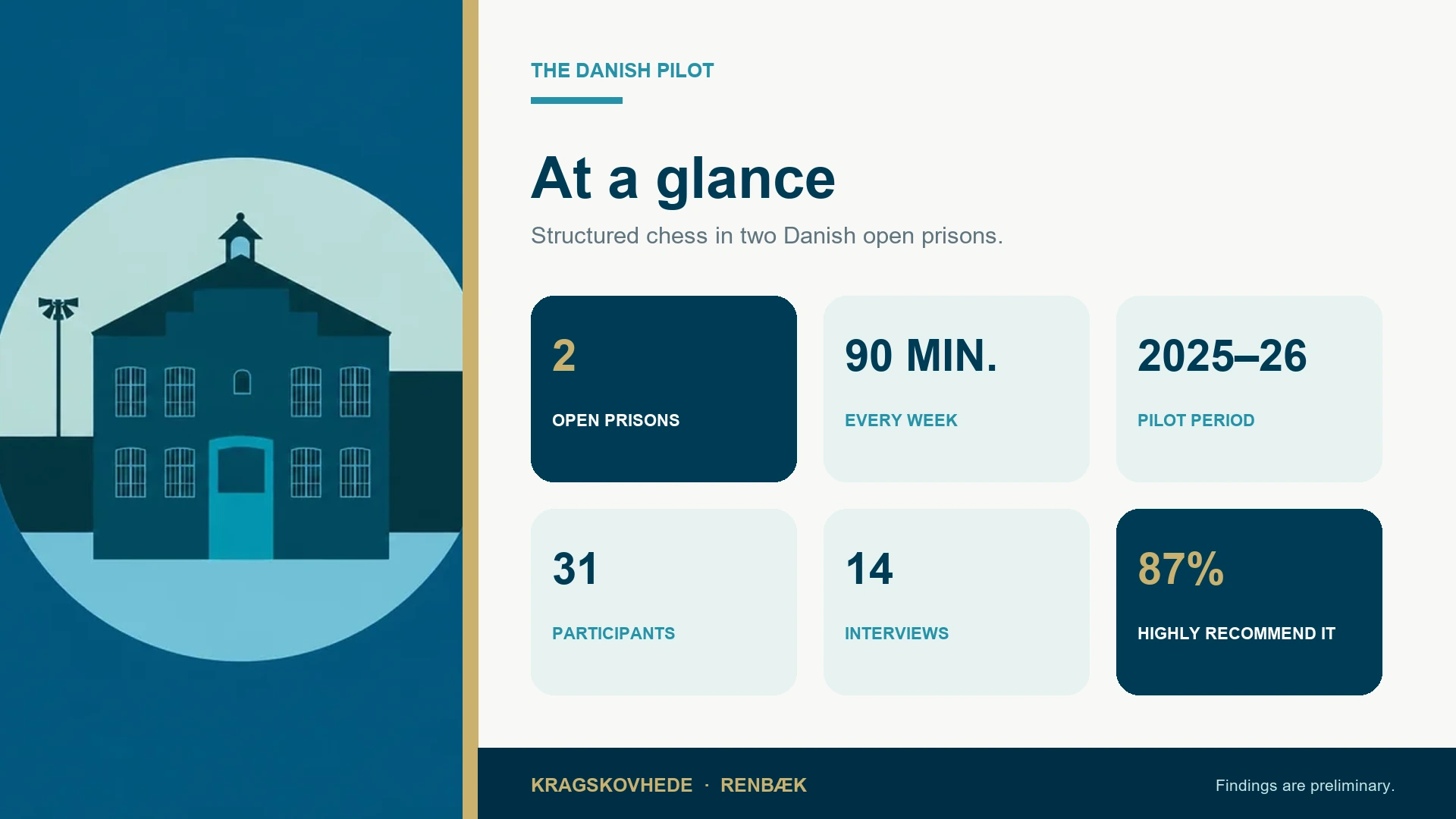
2
Open prisons in the pilot
90 min.
Structured chess every week
14
Research interviews
87%
Highly recommend the programme
Preliminary Findings
Three Connected Areas Of Change
Themes recur across survey responses, interviews and observation.
01
Personal Effects
Improved concentration, calm and mental focus. Chess offers a structured opportunity to pause and consider consequences.
02
Social Effects
New connections across prison units and more constructive contact between inmates and prison officers.
03
Dynamic Security
A calmer atmosphere, less distance and more dialogue can support everyday safety.
Why Dynamic Security Matters
Safety Is Also Built Through Relationships
Dynamic security depends on professional relationships, communication, observation and a stable daily environment—not only physical control.
Shared play can temporarily soften the traditional “us versus them” divide.
“Before I got angry. Now we joke about it.”
— Inmate
Research Design
How The Study Was Conducted
Several kinds of evidence make it possible to compare what participants report with what researchers observe.
Participation Records
Registration data from programme sessions.
Mini-Survey
Responses from 31 participants.
Fourteen Interviews
Ten inmates and four prison officers.
Direct Observation
Four and a half hours across the two prisons.
The findings are preliminary and should not be read as a final impact evaluation or proof of causality.
Research Presentation
Explore The Study
View the eleven-slide presentation from the NSfK Research Seminar 2026.